
Engagement rings are more than symbols of love and commitment; they are reflections of artistic movements, technological innovation, and cultural values. Across the centuries, engagement ring styles evolved dramatically, influenced by fashion, architecture, industrial progress, and changing gemstone-cutting techniques. From the ornate romance of the Victorian era to the geometric precision of Art Deco, each period introduced distinctive aesthetics that continue to inspire modern jewelry design today.
This article explores the major historical periods of engagement ring design, including their characteristic motifs, materials, gold colors, gemstone preferences, and diamond cuts. It also explains when old-cut diamonds were used and how they transitioned into modern brilliant cuts.
Georgian Era (1714–1837)
The Georgian era, named after the reigns of Kings George I through George IV in Britain, represents one of the earliest important periods in engagement ring history. Jewelry during this time was entirely handcrafted, making authentic Georgian rings extremely rare today.
Design Characteristics
Georgian rings were romantic, ornate, and heavily influenced by nature. Popular motifs included:
- Floral clusters
- Bows and ribbons
- Hearts
- Miniature portraits
- Closed-back gemstone settings
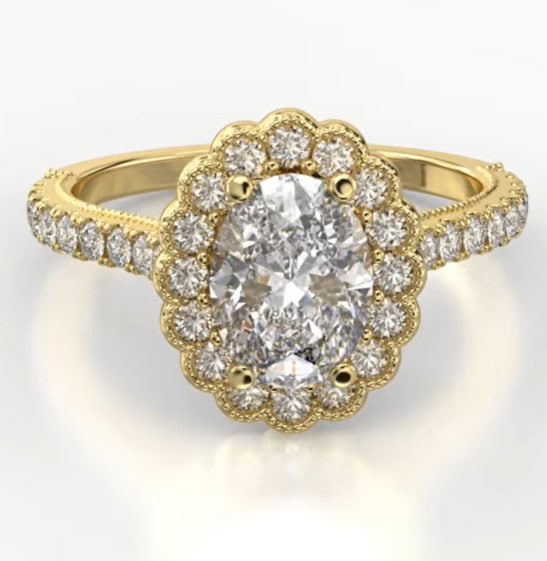
Vintage, Georgian Era Cluster Engagement Ring, image: Diamonds-USA
The craftsmanship was intricate because every detail was created by hand without modern machinery.
Materials and Gold Colors
Yellow gold dominated this period. Jewelers often used high-karat gold, sometimes 18K or higher, because of its rich warm tone and malleability.
Silver-topped gold settings were also common. Since silver visually enhanced the brightness of diamonds under candlelight, jewelers frequently mounted diamonds in silver while or Platinum the rest of the ring remained gold.
Gemstones and Diamond Cuts
Before modern cutting technology, diamonds were shaped by hand and designed to glow under candlelight rather than electric light.
Popular cuts included:
- Rose Cut
- Table Cut
- Old Mine Cut
The Old Mine Cut became particularly important in the late Georgian era. It featured:
- A squarish cushion shape
- High crown
- Small table
- Large culet
- Deep pavilion
These stones produced soft flashes of light rather than the sharp brilliance associated with modern diamonds.
Old Mine Cut diamonds remained popular from the 18th century until the late 19th century.
Victorian Era (1837–1901)
Named after Queen Victoria, this era transformed engagement ring design. Jewelry became more sentimental and accessible thanks to industrialization and the discovery of large diamond mines in South Africa during the 1860s.
Design Characteristics
Victorian engagement rings often symbolized romance and emotion. Common themes included:
- Serpent motifs (inspired by Queen Victoria’s snake engagement ring)
- Flowers and leaves
- Hearts and stars
- Cluster settings
- Hidden messages through gemstones
The Victorian period is usually divided into three phases:
1. Romantic Period (1837–1860)
Highly sentimental and nature-inspired.
2. Grand Period (1860–1885)
Heavier and darker jewelry after Prince Albert’s death.
3. Aesthetic Period (1885–1901)
Lighter, more feminine designs with Japanese and artistic influences.
Materials and Gold Colors
Yellow gold remained dominant, especially rosy and warm tones. Rose gold also became fashionable due to Russian influence and advances in alloy production.
Toward the end of the Victorian era, platinum began appearing in fine jewelry, though it was still rare and expensive.
Diamond Cuts
The Victorian period saw the dominance of the Old Mine Cut and later the development of the Old European Cut.
Old Mine Cut
- Popular until approximately 1890
- Cushion-like appearance
- Hand-cut for candlelight sparkle
Old European Cut
- Emerged around 1890
- Used until approximately the 1930s
- Rounder shape than Old Mine Cut
- Larger facets
- Early predecessor of the modern round brilliant
The Old European Cut became the standard diamond cut during the late Victorian, Edwardian, and early Art Deco periods.
Art Nouveau Era (1895–1910)
Art Nouveau was a short but artistically revolutionary movement that rejected industrial rigidity in favor of flowing natural beauty.
Design Characteristics
Art Nouveau engagement rings emphasized artistry over gemstone size. The style featured:
- Curved flowing lines
- Female figures
- Butterflies and dragonflies
- Orchids and lilies
- Whiplash motifs
- Asymmetry
This era celebrated craftsmanship and creativity.
Materials and Gemstones
Unlike earlier periods focused primarily on diamonds, Art Nouveau jewelers used a wide range of colorful gems:
- Opals
- Moonstones
- Garnets
- Aquamarines
- Enamel
Diamonds often played a secondary role.
Gold Colors
Yellow gold was still dominant because its warmth complemented the organic style. Matte finishes and hand engraving were common.
Diamond Cuts
Old European Cuts were increasingly used during this era, though many rings emphasized artistic composition over large center stones.
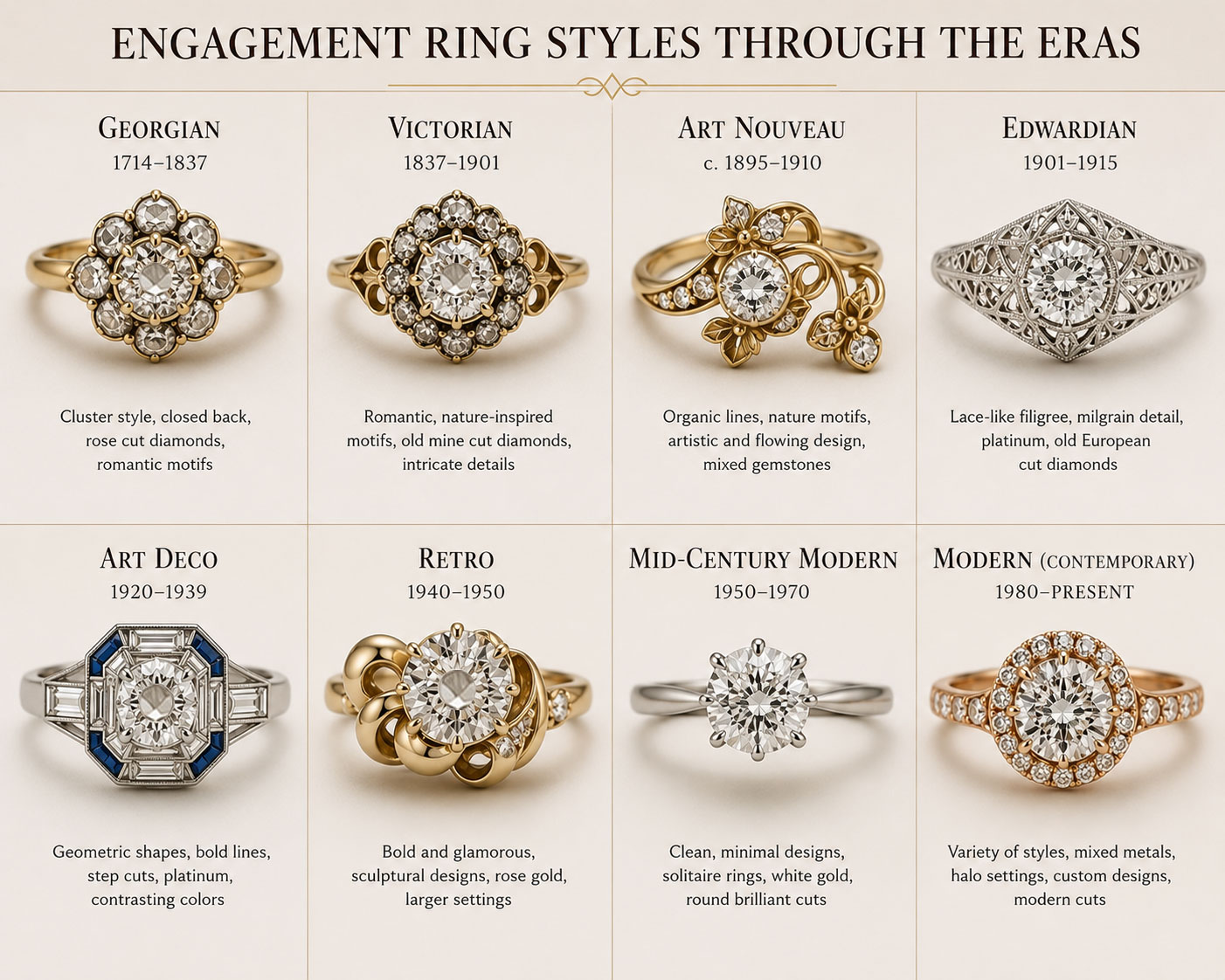
Edwardian Era (1901–1915)
The Edwardian era is considered one of the most elegant periods in jewelry history. The development of platinum transformed engagement ring design.
Design Characteristics
Edwardian rings were delicate, refined, and lace-like. Common elements included:
- Filigree
- Milgrain detailing
- Garlands
- Bows
- Lace-inspired openwork
The overall appearance was light, airy, and sophisticated.
Materials and Metals
Platinum became the defining metal of the Edwardian era because of its strength and ability to hold intricate detail.
White-on-white aesthetics became fashionable:
- Platinum
- White diamonds
- Pearls
White gold had not yet become widespread, so platinum dominated luxury jewelry.
Diamond Cuts
The Old European Cut was the signature diamond cut of the Edwardian period.
Characteristics included:
- Circular outline
- High crown
- Small table
- Open culet
- Soft romantic sparkle
These diamonds were optimized for candlelight and softer indoor illumination rather than the intense brilliance desired today.
Art Deco Era (1920–1939)
Art Deco dramatically changed engagement ring aesthetics. Influenced by modernism, industrialization, jazz culture, and architecture, this era introduced geometric precision and bold symmetry.
Design Characteristics
Art Deco rings are instantly recognizable for their structured elegance.
Key features included:
- Geometric shapes
- Step-cut stones
- Symmetry
- Strong lines
- Contrasting colors
- Architectural inspiration
Designs reflected influences from:
- Egyptian revival
- Cubism
- Machine Age aesthetics
Materials and Gold Colors
Platinum remained extremely popular due to its strength and modern appearance.
White gold also became widely used during this period because platinum shortages during World War I increased demand for alternatives.
Yellow gold appeared less frequently in high-end Art Deco engagement rings, though it remained popular in commercial jewelry.
Gemstones
Art Deco rings frequently combined diamonds with contrasting gemstones such as:
- Sapphires
- Emeralds
- Rubies
- Onyx
Black-and-white contrasts became iconic.
Several cuts became associated with Art Deco:
- Emerald Cut
- Asscher Cut
- Baguette Cut
- Old European Cut
The transition toward the modern brilliant cut began during this era after Marcel Tolkowsky published his revolutionary diamond-cutting proportions in 1919.
However, Old European Cut diamonds continued to be used well into the 1930s.
Retro Era (1940–1950)
World War II significantly impacted jewelry production. Platinum became restricted for military use, leading jewelers back to gold.
Design Characteristics
Retro rings were bold and glamorous, reflecting Hollywood influence.
Popular features included:
- Large sculptural forms
- Oversized settings
- Ribbon motifs
- Three-dimensional shapes
Gold Colors
This period strongly favored:
- Rose gold
- Yellow gold
Warm gold tones dominated because platinum was scarce.
Gemstones and Cuts
Diamonds were still popular, but many rings used:
- Aquamarines
- Citrines
- Synthetic rubies
Round brilliant cuts became increasingly common during this era as diamond-cutting technology advanced.
Mid-Century Modern Era (1950–1970)
The postwar boom created demand for classic diamond solitaire engagement rings.
Design Characteristics
Designs became cleaner and more minimalist.
Popular styles included:
- Solitaire rings
- Thin bands
- Prong settings
- Matching wedding sets
Materials
White gold became highly popular because it resembled platinum but cost less.
Yellow gold also remained fashionable throughout the 1950s and 1960s.
Diamond Cuts
The modern round brilliant cut became dominant during this era due to:
- Improved cutting technology
- Standardized proportions
- Increased emphasis on brilliance
The old cuts gradually disappeared from mainstream jewelry production by the mid-20th century.
Modern Vintage Revival (1980–Present)
Today’s engagement ring market combines modern craftsmanship with historical inspiration. Many buyers seek antique or vintage-inspired rings that reflect individuality and heritage.
Popular Revival Styles
Modern jewelers frequently reinterpret:
- Victorian filigree
- Edwardian milgrain
- Art Deco geometry
- Old Mine and Old European Cuts
Gold Color Trends
Contemporary buyers now choose among:
- Yellow gold
- White gold
- Rose gold
- Platinum
Rose gold experienced a major resurgence in the 2010s due to its romantic vintage appearance.
Antique Diamond Revival
Old-cut diamonds have become increasingly desirable because of their:
- Handcrafted character
- Softer sparkle
- Unique faceting
- Historical authenticity
Collectors especially value:
- Old Mine Cut diamonds (18th century–late 19th century)
- Old European Cut diamonds (1890–1930)
These stones are appreciated not for perfect symmetry, but for individuality and warmth.
Conclusion
The history of engagement rings mirrors the evolution of art, culture, and technology. Each period introduced distinctive design philosophies, materials, and gemstone techniques that reflected the spirit of its time.
- Georgian and Victorian rings emphasized romance and handcrafted artistry.
- Art Nouveau celebrated organic beauty and creativity.
- Edwardian jewelry showcased elegance and platinum craftsmanship.
- Art Deco embraced geometry and modernity.
- Mid-century designs focused on brilliance and simplicity.
Old-cut diamonds played a central role throughout these eras. The Old Mine Cut dominated from the 18th century until the late 1800s, while the Old European Cut remained popular from approximately 1890 until the 1930s, before modern brilliant cuts took over the jewelry industry.
Questions and Answers
Question:
you wrote same dates frame for victorian and art nouvoue, why?
Answer:
Yes, there is an overlap, but historically that overlap is actually correct.
The issue is that these are different classification systems:
- Victorian = defined by the reign of Queen Victoria (1837–1901)
- Art Nouveau = an artistic/design movement (roughly 1895–1910)
So late Victorian jewelry and Art Nouveau jewelry existed at the same time during the final years of the Victorian era.
Edit
very nice. can you change the center diamond cullet to an open one
Edit
no good. the cullet should be almost white