
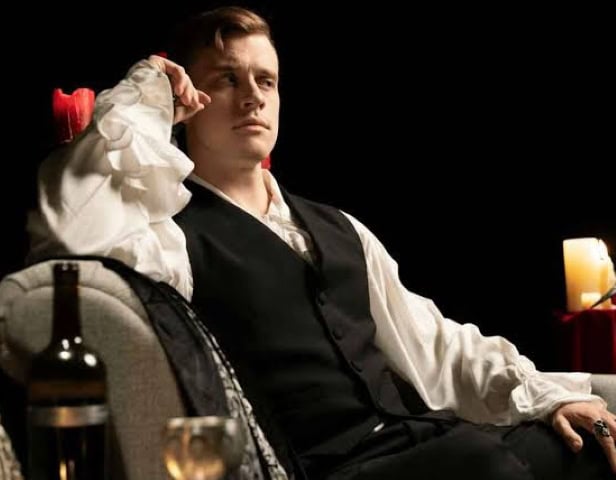
Image from Medieval Collectibles
Alt text: Gothic man lounging.
Knowing how to wear gothic clothing as a deliberate, year-round aesthetic, rather than an accidental Halloween impression, comes down to eight specific styling decisions: anchoring one statement piece, prioritizing construction quality, building around investment pieces, balancing proportion, restraining accessories, respecting historical period, expanding beyond all-black, and wearing the aesthetic consistently across seasons.
The garments themselves are not the problem. The same Victorian dress that reads as a historically informed fashion statement on one woman reads as a costume on another, and the difference lives almost entirely in the surrounding choices. These eight principles are borrowed directly from how vintage stylists approach all historical fashion, and they apply to gothic dressing with the same precision.
Table of Contents
1. Lead With One Statement Piece
2. Well-Made Garments Defeat Costume Associations
3. Three Excellent Pieces Outperform Ten Adequate Ones
4. Proportion Balances Drama Against Overwhelm
5. Restraint in Accessories Confirms Intentional Styling
6. Every Gothic Garment Has a Historical Home
7. Deep Colors Give Gothic Style Its Sophistication
8. Consistent Wear Builds a True Gothic Wardrobe
The Path Forward
1. Lead With One Statement Piece
Vintage stylists working with historical garments consistently anchor one strong period piece against understated contemporary companions. This contrast is what signals intention instead of looking like a costume. Gothic clothing is visually rich by design, meaning a Victorian velvet dress with structured boning or a brocade corset already communicates a complete aesthetic world.
Layering a second richly constructed gothic piece on top of the first tips the visual accumulation from dramatic to overwhelming. The viewer’s eye immediately reads the result as costume logic rather than fashion logic. A Victorian-sleeved velvet dress worn with clean contemporary ankle boots and a minimal structured bag reads as deliberate styling.
The same dress paired with a matching cape, three layered necklaces, and Victorian lace-up boots reads as a costume. The surrounding choices compete with the anchor piece rather than supporting it. A brocade corset needs simple tailored trousers to shine, whereas adding a full romantic skirt and lace gloves buries the garment completely.
2. Well-Made Garments Defeat Costume Associations
A garment with correct historical construction details communicates aesthetic intention through its silhouette, drape, and structural behavior. The viewer’s eye registers this distinction instantly, making a well-made piece read as fashion while a poorly made version looks like a prop.
Fabric weight and fiber composition determine whether velvet or brocade drapes correctly against the body or holds the flat, stiff shape of synthetic theatrical material.
True structural boning holds a bodice tightly in shape during movement, unlike decorative boning that collapses at the waist. A period-accurate silhouette proportion changes the entire read of a garment, especially when a Victorian bodice sits at the correct historical waist point. Synthetic fabric that catches light incorrectly or structural shortcuts that allow the bodice to sag trigger immediate Halloween associations.
Sourcing becomes a precision decision when construction standards matter. Resources like the V&A Museum’s dress archive help calibrate what historically accurate construction should look like. Pieces like the Victorian dresses, corsets, and cloaks found in Medieval Collectibles’ quality dark gothic clothing are built to this calibration level. Fabric weight, boning structure, and period-grounded silhouettes do the communicative work before the garment is ever styled.
| Important: Synthetic fabrics that catch light incorrectly, structural shortcuts that cause bodice sagging, and misaligned historical proportions are the three construction markers that trigger Halloween associations instead of fashion credibility. |
|---|
3. Three Excellent Pieces Outperform Ten Adequate Ones
A gothic wardrobe built around a small number of high-quality pieces creates more styling range than a massive volume of fast-fashion items. A structured velvet coat, a properly boned corset in deep burgundy, and a Victorian-cut dress in quality wool carry sufficient visual weight to anchor multiple outfits. Having ten adequate pieces in the same closet simply reinforces costume-grade coding.
Identify two or three anchor garments first, such as one strong outerwear piece or a dress with genuine historical silhouette integrity. Build outward from those anchors rather than collecting laterally across different clothing categories. Each new addition should extend the range of the anchors already in place instead of introducing an isolated element that requires a complete wardrobe overhaul.
A quality dark velvet coat can successfully anchor an evening outfit, a professional look, and a casual weekend ensemble. A fast-fashion cape fails to anchor any of those contexts convincingly. This wardrobe strategy ensures your closet grows slowly with compounding versatility.
4. Proportion Balances Drama Against Overwhelm
Vintage stylists working with historical garments apply one foundational rule across every era. When a garment carries volume or structural drama, the surrounding pieces must counterbalance it rather than mirror it. A 1950s full circle skirt requires a narrow fitted bodice, since adding volume at the top produces overwhelm rather than drama.
Gothic fashion presents identical proportion challenges. A full-skirted Victorian or dark romantic dress requires a minimal top with no additional volume in the upper half. A dramatic bishop sleeve demands a streamlined trouser or simple skirt with no competing lower-half volume.
A structured boned bodice needs a fluid, uncomplicated skirt that does not assert its own strong silhouette statement. An outfit only reads as a costume when these silhouettes are thrown entirely out of balance. A full-skirted dark romantic dress paired with a voluminous poet blouse simply reads as a miscommunication between garments.
| Pro Tip: Balance visual volume: if your garment has a full skirt, keep the top fitted. A dramatic sleeve requires a streamlined lower half. This proportion rule prevents overwhelm and signals intentional styling. |
|---|
5. Restraint in Accessories Confirms Intentional Styling
Accessory restraint is defined by function rather than quantity. Accessories should deepen the visual world of the outfit instead of piling additional gothic vocabulary onto an already fully stated garment. A Victorian high-collared dress makes a strong aesthetic statement entirely on its own.
Adding a heavy cross pendant, two layered chains, fingerless lace gloves, and a top hat introduces competing additions to a look that requires none. The resulting outfit reads as costume layering because the accessories argue against the main garment. Choosing just one accessory category allows it to extend the outfit’s world naturally.
Select one piece of dark jewelry that echoes a material already present in the garment, or wear a belt that defines the silhouette without introducing new shapes. Dark Victorian drop earrings worn without a necklace against a high-collared blouse look carefully curated. Layering three necklaces over that same blouse just looks cluttered.
6. Every Gothic Garment Has a Historical Home
Gothic clothing, like Gothic skirt outfits, draws from multiple distinct historical periods, each featuring an internal visual logic that cannot be swapped interchangeably. Victorian mourning dress evolved across a long arc from 1837 to 1901, with drastic silhouette changes across sub-periods. The crinoline silhouette of the 1860s, the bustle structure of the 1870s, and the narrower skirts of the 1890s represent distinct visual languages.
Medieval dark romanticism and baroque styles operate under entirely different construction logic regarding drape, weight distribution, and decorative details. Mixing an Edwardian collar detail with a Victorian bustle-era skirt looks like a costume-box assembly to the viewer’s eye. Even if observers cannot name the exact eras, they instinctively recognize that the references do not share a cohesive historical world.
The Fashion History Timeline at FIT serves as a reliable resource for identifying which period a specific garment references. A Victorian piece pairs perfectly with Victorian companions or simple contemporary clothing that asserts no competing historical claim. A modern minimalist piece in a dark tone can accompany any historical garment because it never fights the primary visual anchor.
| Key Insight: Mixing an Edwardian collar with a Victorian bustle-era skirt, or a medieval overdress with Victorian boning, reads as costume-box assembly because the historical references don’t share a visual world, even if the viewer can’t name why. |
|---|
7. Deep Colors Give Gothic Style Its Sophistication
All-black gothic dressing is the fastest route to a costume read because Halloween outfits default to that same shorthand. The full gothic palette actually encompasses a wide range of deep historical colors. Deep burgundy, forest green, midnight navy, charcoal grey, and oxblood are the tones that dark romantic fashion has utilized for centuries.
Victorian mourning dress moved through defined stages, transitioning from solid black into muted purples, greys, and lavenders after the prescribed deep mourning period concluded. Medieval and dark baroque dress used saturated jewel tones as status markers, since richly dyed fabric communicated wealth and position. The all-black gothic wardrobe is a late-twentieth-century subculture convention that strips the aesthetic of its true historical depth.
Introducing this historical palette only requires selecting one non-black dark jewel tone as an accent in an otherwise dark outfit. A forest green velvet coat over a black underlayer or a deep burgundy corset in a charcoal ensemble introduces color sophistication without abandoning the dark register. Wearing these deeper shades remains contextually appropriate in early autumn or December, effectively expanding the wardrobe’s temporal range.
8. Consistent Wear Builds a True Gothic Wardrobe
Wearing gothic clothing strictly during seasonal events signals to the viewer that the wearer is engaging in a performance. This seasonal pattern confirms the Halloween association because October is precisely when costumes appear. Wearing a dark velvet coat in February or a Victorian-inspired blouse in April communicates something structurally different.
A well-cut dark velvet coat works perfectly across autumn and winter when styled over work clothing or evening dress. A Victorian-inspired blouse in a deep jewel tone works for spring and summer, tucking into contemporary trousers just as easily as it does a full skirt. A quality boned corset serves as a waist-defining layering piece over a structured shirtdress in any season.
Year-round gothic styling relies entirely on correctly constructed garments. Costume-tier items are built for occasional deployment and visually announce their lack of durability. Historically accurate gothic clothing is built for repeated, multi-context wear.
The Path Forward
Gothic fashion draws from centuries of European dress history, giving it a range that purely contemporary dark fashion cannot offer. The same skills used to assess vintage clothing directly determine whether a gothic aesthetic succeeds or fails. Mastering historical silhouettes, period coherence, proportion balancing, and fabric quality assessment prevents these garments from looking out of place.
Applying restraint to statement pieces and prioritizing high-quality construction changes how gothic clothing functions in daily life. A wardrobe built on well-crafted Victorian dresses, durable cloaks, and properly boned corsets outperforms a collection of flimsy seasonal garments.
| Author Profile: Medieval Collectibles is the leading online retailer of authentic medieval replicas and fantasy collectibles for history enthusiasts, reenactors, and collectors worldwide. |
|---|