
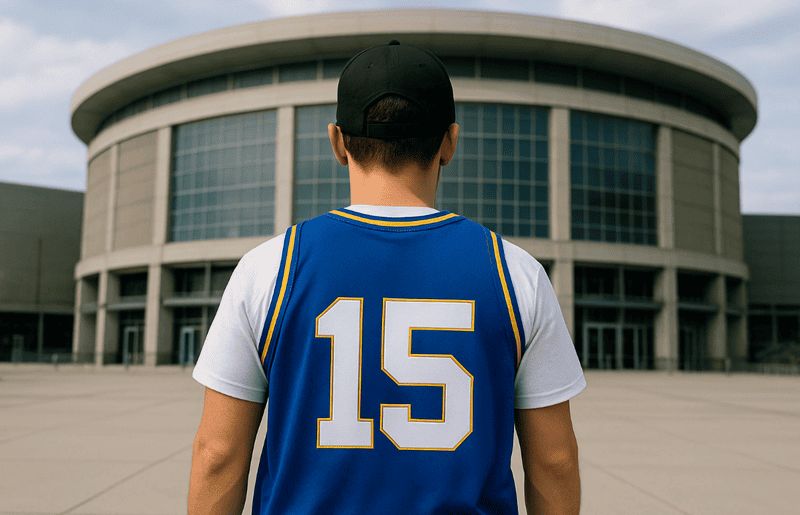
Image from Sports Gear Swag
Alt text: Man in blue jersey facing arena.
The sports jersey has a fashion history as richly documented and as decade-specific as the trench coat, the denim jacket, or the band tee. It has simply been less formally catalogued.
Each decade’s relationship with the jersey as a non-athletic garment reveals that era’s broader fashion values as clearly as its dominant silhouettes or color palettes do, making the jersey one of the most reliable cultural indicators in the vintage wardrobe.
This is a sports jersey fashion history written for people who take vintage dress seriously, featuring seven defining moments, specific garments, styling conventions, and contemporary approaches to wearing the aesthetic today.
Table of Contents
1. The 1930s 40s Baseball Shirt Method
2. The 1950s Tucked Bowling Shirt
3. The 1960s to 70s Counterculture Mix
4. The 1970s to 80s Collegiate Status Look
5. The 1980s Oversized Streetwear Fit
6. The 1990s Global Basketball Aesthetic
7. The Y2K Maximalist Statement
The Path Forward
1. The 1930s to 40s Baseball Shirt Method
Post-Depression America produced the first documented instance of a purpose-built athletic jersey worn deliberately for its aesthetic and comfort properties rather than its sporting function.
The wool or cotton flannel baseball shirt featured a full-button placket, team lettering across the chest, and a relaxed fit built for outdoor use throughout the season. Working-class and youth leisure culture began wearing these shirts open over plain undershirts as an early form of casual layering.
The open-layer approach anchored the look in neighborhood identity and informal male dress without the formality that characterized mainstream menswear of the period. Smithsonian Magazine and sports history archives document baseball’s near-total dominance of American social life during this era, making the flannel shirt’s crossover into leisure dress historically logical.
Authentic 1930s and 40s baseball flannels are structurally fragile and appear only occasionally at estate sales and specialist vintage dealers.
Because standard charity shops rarely carry intact originals, sourcing alternatives has become standard practice for modern collectors. Many enthusiasts rely on modern reproduction platforms like Sports Gear Swag’s custom jerseys in vintage-inspired styles to recreate the relaxed cuts of the era without risking damage to delicate vintage threads.
Whether using a careful reproduction or a lucky estate sale find, wearing the piece open over a plain white crew-neck tee with straight-leg trousers keeps the layering method historically grounded.
2. The 1950s Tucked Bowling Shirt
The bowling shirt carried the same design DNA as the traditional athletic jersey through a team or employer name on the back, bold color blocking, and contrasting yoke panels. Rayon or gabardine construction alongside a camp collar translated the jersey’s visual language into mass-market menswear with unprecedented directness.
Bowling was the most participated-in American sport of the decade, and the convention that leisure activities deserved their own uniform drew a direct line from team athletic identity to leisure group identity.
Participants wore the bowling shirt tucked into high-waisted slacks with suede shoes or loafers, treating it with the same intentionality as a work shirt while reserving it for weekend wear. Authentic 1950s bowling shirts surface reliably at thrift stores and estate sales today, offering consistent supply even if condition and sizing vary.
Wear one tucked or half-tucked with wide-leg trousers for decade accuracy, or layer it open over a fitted ribbed turtleneck for a vintage-informed interpretation.
3. The 1960s to 70s Counterculture Mix
Wearing a stranger’s team jersey became a deliberate aesthetic and political choice for the counterculture rather than an economic accident. The V&A Museum’s fashion archives document this specific relationship with found clothing, placing the sports shirt alongside army surplus and patchwork denim as a garment worn in deliberate opposition to mainstream brand-consciousness.
The found quality of the garment was the entire point, meaning the more evidently thrifted and worn the piece appeared, the more authentic the look.
The primary garments defining this era were raglan-sleeve baseball tees with contrast-color sleeves and early mesh football jerseys. These specific constructions provide reliable period identifiers for vintage athletic wear style enthusiasts today, as the lighter mesh predates the heavier NFL-style fabrics of the following decade.
Genuine 1960s to 70s raglan tees remain findable in well-stocked vintage stores, where faded fabrics and worn seams act as evidence of authenticity. The contemporary approach involves wearing a raglan tee over a long-sleeve thermal with wide-leg corduroy, prioritizing authentic seam placement over the specific team name on the chest.
| Quote: Wearing a stranger’s team jersey, someone else’s name and someone else’s number, was simultaneously an anti-fashion gesture and the creation of an entirely new fashion vocabulary: the found quality of the garment was the point. |
|---|
4. The 1970s to 80s Collegiate Status Look
The college athletic department jersey became a marker of access and cultural capital by the late 1970s. Wearing a university name on your chest communicated membership in an aspirational institution while signaling a confident, casual approach to daily dressing. Students and fans adopted mesh football practice jerseys in school color combinations and thick-knit basketball shirts into their off-campus wardrobes.
The 70s era’s styling convention paired these pieces with straight-leg jeans, tube socks, and casual leather shoes. This specific combination mixed athletic and casual references in a way that characterized forward-looking fashion and helped separate sportswear from active use.
Collegiate athletic jerseys from this period remain among the most reliably available vintage finds on the thrift market, especially in charity shops near university towns. Their continued presence on resale racks speaks to a broader fashion comeback of classic sports uniform styles that collectors and style-conscious buyers actively seek out. Pairing a lettered mesh jersey with high-waisted straight-leg jeans reads immediately across multiple contemporary styling registers.
5. The 1980s Oversized Streetwear Fit
American football jerseys built for physical contact began appearing in urban street fashion contexts during the early 1980s. The oversized construction proved functional for the sport and visually striking for the street, producing the dropped shoulders and extended body length that defined the decade’s aesthetics.
Heavy mesh NFL-style jerseys featured bold number graphics, side panel construction, and team color blocking that functioned as statement anchors without additional styling work.
Hip-hop’s early aesthetic vocabulary and its deliberate relationship with sports dress are heavily documented in fashion journalism from GQ and Highsnobiety. The NFL’s expanding cultural footprint through network television created the broadcast infrastructure that made these garments recognizable as fashion choices rather than simple athletic wear.
Authentic 1980s NFL and college football jerseys appear regularly in thrift stores, though specialized resale platforms command higher prices for well-preserved examples. Wear one or two sizes larger than your standard fit over a fitted long-sleeve layer, keeping the rest of the outfit minimal with track pants and shell-toe sneakers.
| Key Insight: The football jersey’s oversized construction was functional for the sport and visually prescient for the street: worn large, it produced the exaggerated proportions, dropped shoulders, extended body length, graphic chest panel that defined the decade’s most forward-looking looks. |
|---|
6. The 1990s Global Basketball Aesthetic
Hip-hop artists and NBA players wore basketball jerseys multiple sizes up during the 1990s, broadcasting the image simultaneously through music videos and magazines to audiences worldwide.
The player name and number on the back shifted function to become style data, meaning choosing which jersey to wear became a deliberate fashion decision. The garments featured satin-finish or heavy mesh constructions, prominent player names, large back numbers, and deep armholes.
The NBA’s global reach combined with the hip-hop industry’s documented fashion influence created a feedback loop between sport and fashion that accelerated athletic design trends. Sports brands used this exact moment to pivot from athletic suppliers into lifestyle companies with genuine fashion-market ambitions.
The 1990s represent the richest hunting ground for vintage jersey shoppers today, with NBA, NFL, and MLB pieces surfacing constantly on resale platforms. Committing to full decade accuracy requires layering an oversized jersey over a white tee with baggy shorts, while a refined approach involves partially tucking the piece into high-waisted trousers.
| Pro Tip: The 1990s represent the richest hunting ground for vintage jersey shoppers; NBA, NFL, and MLB jerseys from this period surface constantly in thrift stores and on resale platforms, often in excellent condition at accessible prices. |
|---|
7. The Y2K Maximalist Statement
Sports branding and athletic silhouettes crossed from subcultural fashion into mainstream mass-market dress in the early 2000s. The visual language of the jersey dominated pop music, celebrity culture, and high-street fashion simultaneously. Sammy D Vintage’s documented analysis of Y2K thrift and styling confirms the heavy reliance on athletic branding in this era, corroborating archival coverage from Vogue Runway.
The Y2K aesthetic used the jersey’s design features as pure style currency completely detached from team loyalty. Fashion enthusiasts wore football jerseys as dresses with micro-skirts underneath and adopted logo-heavy tracksuits as evening-adjacent going-out wear. Mesh panels, licensed branding, and bold number graphics operated as decorative design features first and sporting identifiers second.
Y2K-era licensed sports apparel remains a high-volume category in vintage shops targeting the current revival market. Wearing this aesthetic with contemporary authority requires committing to the era’s maximalism through visible branding, bold colors, and layered proportions. Styling a basketball jersey as a top with cargo trousers and chunky platform sandals reads as decade-accurate and fashion-forward in the current revival context.
The Path Forward
The sports jersey’s migration from the baseball diamond to the everyday wardrobe highlights a century of evolving fashion priorities. From the heavy flannel button-downs of the 1930s to the oversized basketball mesh of the 1990s, each iteration transformed highly functional activewear into a recognizable cultural uniform.
Finding authentic pieces from these specific eras requires navigating vintage racks for raglan seams, rayon camp collars, or heavy-knit collegiate lettering.
| Author Profile: Sports Gear Swag is the leading online retailer of custom sports apparel and gear for teams, schools, and organizations of all sizes. Specializing in team jerseys, uniforms, and athletic apparel with a wide range of customization options. |
|---|