
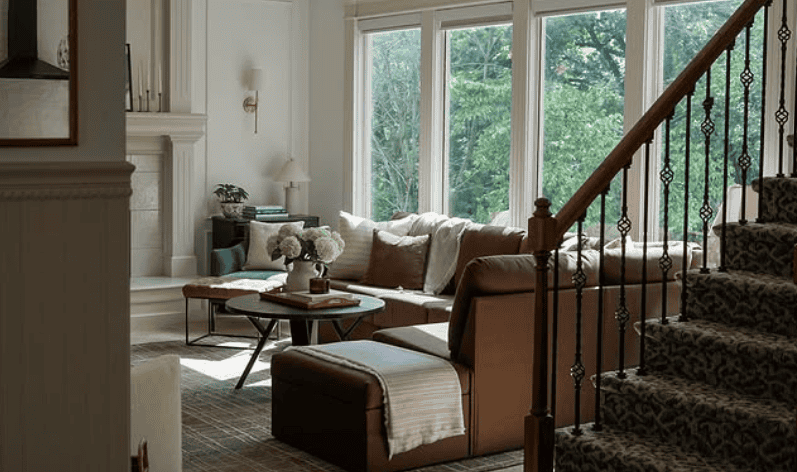
Image from Home Reserve
Alt text: A cozy living room with large sectional sofa and bright windows.
The most common failure in vintage-inspired interior design is not a wrong choice of furniture or a mismatched color. It is a room that has been styled so carefully that nobody actually wants to spend time inside. Every cushion is plumped into rigidity, while every surface feels too considered to touch. The silhouettes and patina might look correct, but the room functions entirely as a display rather than a space for living in.
Historically correct rooms that prioritise aesthetics over experience end up working as museum wings. Guests perch at the edge of chairs, and children are actively discouraged from entering.
The sofa looks perfect in photographs but feels punishing after twenty minutes. You can bridge this gap by keeping historical references while making the room genuinely comfortable enough to use for Saturday morning coffee, homework sessions, and long film nights.
The vintage-inspired rooms that actually work combine historical aesthetic references with furniture and materials chosen for daily use rather than preservation. Seven specific design decisions separate the beautiful room nobody uses from the space nobody wants to leave.
You can achieve this balance without complicated renovations or a specialist sourcing budget. Start where most layouts go wrong, which is usually the primary seating.
Table of Contents
1. Anchor the Room With a Sofa You Can Actually Sink Into
2. Pile On Period-Appropriate Textiles
3. Pick a Palette That Belongs to an Era
4. Let Real Vintage Finds Do the Heavy Lifting
5. Make the Walls Work for You
6. Light the Room for Atmosphere
7. Edit Until the Room Feels Chosen
The Bottom Line
1. Anchor the Room With a Sofa You Can Actually Sink Into
Victorian and Edwardian seating was engineered for corsets, calling cards, and short formal visits. Seat depths were shallow by design, and the furniture assumed that visitors would not be staying long enough to need genuine support.
Attempting to source period-accurate seating for a vintage-inspired living room today means importing all of those ergonomic failures into a space where modern humans need to sprawl comfortably through a Sunday afternoon.
The modern solution relies on contemporary furniture with historically sympathetic proportions and fabric choices. This creates visual harmony with the room’s aesthetic references without sacrificing the comfort a modern body actually needs.
A vintage aesthetic living room requires a central seating piece that provides genuine depth rather than the shallow dimensions of period-accurate options. It must also offer a generous scale that suits older home proportions while carrying upholstery that looks period-appropriate without requiring specialist cleaning.
Among the contemporary options built for this exact problem, Home Reserve’s large deep-seat sectional with hidden storage earns its place through the specific qualities an older space needs in an anchor piece. The 24-inch seat cushions provide genuine lounging depth, which makes a room feel inhabited rather than staged. This modular L-shape also suits the generous proportions of a Victorian or Edwardian sitting room without looking undersized or squeezed into a corner.
Fabric selection serves as the primary aesthetic bridge between eras. A boucle option carries a mid-century texture that looks tactile and historically warm against a period palette, while performance velvet delivers the quietly luxurious finish that older homes have always favored.
Alternatively, flannel choices in deep charcoal or blueberry provide the color saturation that Victorian and Edwardian palettes rely on. Any of these fabric choices positions the seating as the era reference instead of an awkward modern compromise.
Practical features matter just as much as historical aesthetics. Machine-washable covers mean the family can use the space daily without treating the furniture as a precious artifact.
Hidden under-seat storage keeps modern items out of sight, preserving the curated look of the room without requiring a visible pile anywhere. Once the central seating functions properly, the surrounding textiles can handle the rest of the layering work.
| Quote: The most successful vintage-inspired rooms don’t sacrifice comfort for accuracy. Start with a sofa that invites lounging deep seats, period-sympathetic fabric and the room will feel lived in, not museum-preserved. |
|---|
2. Pile On Period-Appropriate Textiles
Texture is the fastest and lowest-cost way to make a vintage-inspired room feel inhabited rather than staged. It signals that the area is meant for living in, and it achieves this without requiring a single structural change. Vintage style home decor ideas that skip this step produce results that look correct from the doorway but oddly cold from the sofa.
For throws, choose wool, chunky knit, or fringed cotton draped loosely over an armrest rather than folded into a neat square. A folded textile reads as a display piece, while a draped one indicates actual use.
Mix cushion fabrics like tapestry covers, embroidered linens, and velvet in odd numbers with no matching sets. Period rooms mixed textiles by material and color rather than using coordinated retail collections.
Modern versions of these historic patterns are widely available through high-street retailers, online resale platforms, and charity shops. A sectional with generous proportions and a period-sympathetic fabric becomes the natural backdrop that makes textile layering look intentional. The composition holds together because the anchor piece has the proper scale to carry it.
3. Pick a Palette That Belongs to an Era
Contemporary neutral palettes like warm white or soft oat actively read as modern regardless of what period furniture sits in front of them. A Victorian-inspired living room painted in a warm greige will just look like a contemporary house with old furniture inside. Color acts as a direct era signal, which means contemporary neutrals belong firmly to the current decade.
Historically grounded palettes break down clearly by period depending on your target aesthetic. Victorian rooms used deep forest green, burgundy, navy, ochre, and terracotta to absorb candlelight and create layered warmth.
Edwardian and Arts and Crafts rooms favored sage, dusty rose, warm ivory, and peacock blue for a lighter touch anchored in natural pigments. Mid-century spaces worked with mustard, burnt orange, olive, and walnut brown to create a warmer, more graphic environment.
You only need to pick one dominant color from the appropriate historical palette and apply it to a single wall or large textile. Let the rest of the room respond and recede around that anchor point.
Full-room commitment is not required, and repainting every wall is unnecessary. Deliberate upholstery choices already accomplish much of this palette work, positioning your main seating as the era anchor without opening a single paint tin.
4. Let Real Vintage Finds Do the Heavy Lifting
Reproductions undermine a vintage home decor living room in a way that is difficult to articulate but immediately felt. Real historical objects carry age, surface texture, and material history that a copy simply cannot replicate.
Details like the slight foxing on a print or the worn edge of a leather tray add genuine weight to the space. A room full of reproduction accessories looks like a themed set, whereas a room with three or four genuine objects actually possesses a history.
Sourcing authentic period pieces requires less specialist effort than most decorators assume. Charity shops, estate sales, antique markets, and online resale platforms are all productive and low-cost hunting grounds.
The specific vintage finds that do the most work include framed botanical prints with aged mounts, ceramic candlesticks, and old hardback books stacked horizontally. You can also use worn leather or wooden trays for surface grouping and styling.
Two or three genuine objects will always do more visual work than an entire shelf of modern reproductions. Choosing items built to last mirrors the philosophy behind furniture designed for decades of use rather than a single decorating cycle. Both are investments in a space that improves with time rather than dating quickly.
| Key Insight: A handful of genuine vintage objects a foxed print, a worn leather tray carry a history that reproductions can’t replicate. Two or three authentic pieces do more work than a shelf of copies. |
|---|
5. Make the Walls Work for You
Blank or plainly painted walls read as contemporary regardless of what stands in front of them. In a vintage aesthetic living room, walls act as an active design surface that carries color depth and pattern. Since floor-level furniture alone cannot supply enough historical character, a room with correct seating and bare white walls will still read as a modern box.
Four specific wall interventions can resolve this starkness without requiring a full renovation. Painting a single wall in a dark, historically grounded tone like forest green or deep burgundy anchors the room’s depth immediately.
A large-scale mirror in an ornate frame adds period character while bouncing light to make the space feel larger. You can also hang a gallery wall of mismatched vintage frames in varying sizes, or apply period-appropriate wallpaper on a single feature surface.
You only need to treat one wall to shift the mood of the entire area. A single treated surface changes the room’s register without touching the other three boundaries, taking an afternoon rather than a full weekend to complete.
6. Light the Room for Atmosphere
Overhead lighting strips atmosphere from a vintage-style home decor space faster than almost any other design factor. Cold-toned bulbs flatten surfaces, kill natural shadows, and look aggressively modern regardless of your other styling choices. A Victorian-palette living room lit by recessed LED downlights at 4000K will just feel like a sterile waiting room with antique furniture scattered around.
Layered warm light sources solve this starkness directly. Table lamps with pleated linen or stained glass shades positioned beside the sofa create the mid-level warmth that older homes relied on.
A floor lamp with a warm-toned bulb directed at a corner adds volume without generating a harsh glare. Picture lights mounted above artwork or mirrors add depth and direct attention to your genuine thrifted finds, making those objects work harder at night.
Upgrading your bulb specifications costs almost nothing but changes everything about the environment. Install warm-toned LED bulbs at 2700K or lower in every single fixture. Simply switching the overhead lights off after dusk and relying on three scattered lamps will make the room feel like a completely different space within sixty seconds.
| Pro Tip: Swap overhead lights for warm-toned lamps after 5 pm. A single 2700K bulb in a fabric-shaded table lamp transforms the room’s atmosphere instantly, with zero renovation. |
|---|
7. Edit Until the Room Feels Chosen
Vintage-inspired rooms fail when every interesting object is displayed at once. The space stops reading as curated and starts reading as chaotic, which makes the floorplan feel smaller and harder to relax in. This accumulation trap is particularly easy to fall into when sourcing from estate sales, since the low cost of individual pieces makes the temptation to buy everything constant.
Each surface should tell one small, coherent story that is grouped by material, color, or scale. A brass candlestick, a worn leather tray, and a stack of hardbacks give the eye a logical place to rest.
Seven unrelated objects arranged by proximity act as a retail inventory rather than a design choice. Learning how to decorate a vintage living room without accumulation means editing down to the essentials.
You can practice a simple editing method by removing half the objects from any surface for a full day. Return only the pieces whose absence was actively noticed, and place the rest into hidden storage. Extra throws, remote controls, and seasonal items can disappear into built-in furniture compartments, leaving surfaces clean and the room’s composition intact.
The Bottom Line
The most successful vintage-inspired living room is not the most historically accurate one, but rather the one a family never wants to leave. It allows a dog on the cushions and coffee on the side table without anyone reaching for a coaster out of anxiety. Achieving this requires layered period-appropriate textiles, a historically grounded color palette, and genuine found objects rather than expensive renovations.
A deep, genuinely comfortable central seating piece acts as the non-negotiable anchor of this equation. Without proper support, every other design choice just layers atmosphere onto a room that actively discourages sitting. Taking advantage of hidden compartments inside that anchor seating handles the modern clutter that historical curation alone cannot solve.
| Author Profile: Home Reserve is the leading manufacturer of adaptable modular furniture for families seeking durable, sustainable solutions for everyday living. |
|---|