
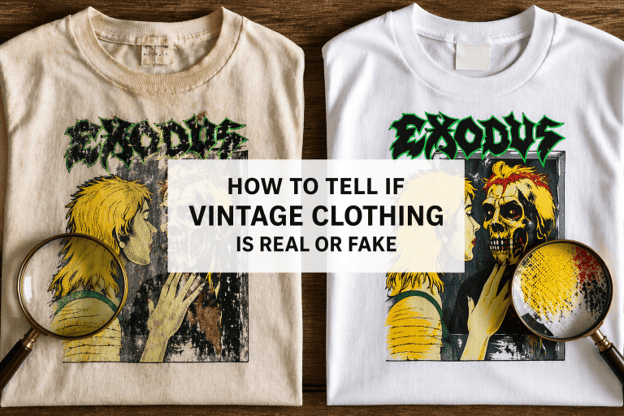
So, you’re diving into the world of vintage clothes? Wonderful! But figuring out what is genuinely old, and what’s just pretending to be, is the first thing you’ll want to learn. Plenty of things are sold as vintage, but aren’t actually modern copies, or simply second-hand items mislabeled.
Thankfully, it’s not overly complicated to tell the difference; you don’t need to be an expert. Just understanding a handful of core things will make it a lot easier to know what’s authentic.
How to Tell If Vintage Clothing is Real or Fake
Give it time, and the more you see, the easier it will become.
Start with the Label
Most people look at the label first, and rightly so.
Vintage labels are generally quite simple, typically showing just the brand name and often the place where it was made. You won’t find the long lists of care instructions or detailed fabric content you get nowadays, nor will you see barcodes.
Contemporary labels have a lot more information and appear very neat and finished. If a label looks too new or overly detailed, it’s a flag that it might not be a true vintage item.
However, don’t only look at the label. Some truly vintage items have no label at all, and some fakes will copy old label styles.
Examine the Fabric
The fabric is often one of the simplest ways to differentiate between genuine vintage and a fake.
Clothes from earlier periods were usually made with natural fibers – cotton, wool, silk, and rayon. These materials generally feel heavier, softer, or have more structure than today’s fast fashion fabrics.
Lots of polyester? It’s probably not from the period claimed. Polyester became widespread later and is a helpful indicator. And crucially, feel the fabric. If it feels too modern, too flimsy, it might not be vintage.
Consider the Stitching
Stitching reveals more than you think. Vintage stitching is often simpler. It may not be perfectly in a straight line, especially with older or hand-made items.
Modern clothing generally has very precise, even stitching because of modern machinery. If it’s too perfect, it’s likely newer. Slight imperfections, in fact, can be a positive sign with vintage.
Inspect Zippers and Closures
Those little details, zippers, and buttons are really useful. Zippers in older clothes were frequently metal. Plastic ones came later. A metal zipper suggests age.
Buttons also offer clues. Vintage buttons are commonly metal, glass, or early forms of plastic, and will usually show some age. These are trickier to replicate, so they are helpful for checking.
Pay Attention to the Overall Shape
The cut and form of the garment will tell you a lot about its authenticity.
Each decade had its own distinctive style. Clothes from the 1950s, for instance, are frequently fitted at the waist and have a more defined shape. Other eras have different shapes. Modern pieces attempting to copy these styles don’t always get the proportions quite right.
If the shape feels too contemporary, or a little bit ‘off’, it’s probably not from the intended era.
Look for Signs of Age
Genuine vintage will typically show some natural wear and tear. This isn’t damage, but things like slight fading, a softer feel to the fabric, or gentle wear along the seams.
Something that looks completely as-new, but is supposed to be old, should be examined carefully. Natural aging is hard to perfectly mimic, and so is a telling sign.
Be Aware of Reproductions
Lots of brands now create clothes in the style of vintage. These are designed to look old, but are in fact new. They may copy label designs, patterns, or cuts.
The difference is usually in the details. A reproduction might have a vintage-style design but include modern things like care labels or fabric percentages. Look at the whole thing, not just one element.
Put It All Together
The most reliable way to tell if vintage clothing is genuine is to look at everything together. Don’t rely on just one thing. Check the label, fabric, stitching, hardware, and the overall shape. When all of these elements correspond to a particular period, it’s more likely to be authentic. If something doesn’t feel right, trust your instinct and examine it more closely.
Wrap Up
It takes a little practice to learn to tell real vintage from fake, but it gets easier as you go. You don’t need to know everything at once. Just focus on the fundamentals and grow your knowledge gradually.
Check labels, feel the fabric, and pay attention to details. These simple steps will help you avoid mistakes and make better purchasing decisions.
With time, you’ll be much more confident and able to spot authentic vintage much more quickly. And once you can, building a real vintage wardrobe is all the more satisfying.